The software development landscape is currently undergoing its most significant transformation since the advent of high-level programming languages. For years, developers have leveraged Integrated Development Environments (IDEs) and basic automation to speed up their workflows. However, the emergence of agentic AI coding marks a fundamental shift from tools that merely assist to systems that can act autonomously.
As business leaders and technical decision-makers look to optimize their engineering pipelines, understanding the distinction between simple AI assistance and true agentic workflows is crucial. This article explores the mechanics, benefits, and future of agentic AI coding, providing a comprehensive guide for those looking to stay at the forefront of technological innovation.
Introduction: Why Agentic AI Coding Is Emerging as a Major Trend
In the last two years, the industry was captivated by “AI-assisted coding” tools like GitHub Copilot and ChatGPT. These tools function primarily as advanced autocomplete systems, suggesting snippets of code based on the immediate context of a file. While they have undoubtedly improved developer productivity, they still require a human to drive every step of the process: writing the prompt, reviewing the code, integrating it into the codebase, and debugging errors.
Agentic AI coding is the next logical step in this evolution. It refers to AI systems that don’t just suggest code but act as “agents” capable of reasoning, planning, and executing complex tasks with minimal human intervention. This trend is gaining momentum because Large Language Models (LLMs) have reached a level of reasoning capability where they can interact with external tools—such as terminals, browsers, and file systems—to solve problems end-to-end. For businesses, this means the potential to move from “human-led, AI-supported” development to “AI-led, human-governed” development.
Definition: What Agentic AI Coding Means
At its core, agentic AI coding is the application of autonomous AI agents to the software development lifecycle (SDLC). Unlike a standard chatbot, an agentic system is designed to achieve a high-level goal (e.g., “Add a user authentication system to this dashboard”) by breaking it down into smaller, actionable steps.
An agentic system possesses a degree of agency. It can observe its environment, make decisions based on what it sees, and take actions to change that environment. In the context of coding, this means the AI can read an entire repository, understand the dependencies, write the necessary code across multiple files, run tests to verify the implementation, and iterate on the solution until the goal is met.
Difference Between Agentic AI Coding and AI-Assisted Coding
To appreciate the value of agentic systems, one must understand how they differ from the assisted coding tools currently in widespread use.
- Level of Autonomy: AI-assisted coding is reactive. It waits for a developer to type a character or a comment before offering a suggestion. Agentic AI is proactive; once given a task, it works independently until the task is complete or it requires clarification.
- Scope of Context: Assisted tools usually focus on the current file or a small window of code. Agentic systems are designed to ingest the entire context of a project, including documentation, architecture diagrams, and existing pull requests.
- Task Complexity: Assisted coding is best for micro-tasks (writing a function, generating a unit test). Agentic coding handles macro-tasks (refactoring a legacy module, migrating a database, or building a full-stack feature).
- Tool Interaction: Assisted tools live inside the code editor. Agentic systems can leave the editor to search the web for documentation, use a CLI to install packages, or trigger a CI/CD pipeline.
Key Characteristics of Agentic AI Systems
What makes a system “agentic”? There are five primary characteristics that define these advanced platforms:
- Autonomy: The ability to operate for extended periods without human intervention. The agent manages its own state and tracks progress toward the final goal.
- Planning: Before writing a single line of code, an agentic system creates a roadmap. It identifies which files need modification and what new components are required.
- Tool Usage: Agentic AI can interact with the “real world” of development. This includes using compilers, linters, debuggers, and web browsers to gather information or validate work.
- Iteration: If an agent encounters an error (e.g., a failed test), it doesn’t stop. It analyzes the error message, adjusts its code, and tries again. This self-correction loop is a hallmark of agency.
- Feedback Loops: These systems can solicit feedback from humans at critical junctures, ensuring that the autonomous work remains aligned with business requirements.
How Agentic AI Coding Works: A Step-by-Step Explanation
The workflow of an agentic AI system is more akin to a human developer’s thought process than a simple text generation algorithm. Here is how it typically operates:
- Goal Ingestion: The user provides a high-level objective in natural language (e.g., “Fix the memory leak in the data processing service”).
- Environment Analysis: The agent scans the codebase to understand the architecture, tech stack, and relevant logic. It might run existing tests to establish a baseline.
- Task Decomposition: The agent breaks the goal into a sequence of steps: “Step 1: Profile the application. Step 2: Identify the leaking object. Step 3: Modify the garbage collection logic. Step 4: Verify with tests.”
- Execution and Tooling: The agent begins writing code. If it needs to check a library’s documentation, it “browses” the web. If it needs to see if a change works, it executes a command in a sandboxed terminal.
- Validation: The agent runs the test suite. If tests fail, it enters a debugging loop, inspecting logs and stack traces to refine the code.
- Submission: Once the agent is satisfied, it presents the completed work—often as a Pull Request (PR)—for human review.
Examples of What Agentic AI Coding Can Do in Real Projects
Agentic AI is already proving its worth in complex, real-world scenarios:
- Legacy Code Migration: An agent can be tasked with migrating a frontend from Vue 2 to Vue 3, identifying deprecated APIs across hundreds of files and replacing them with modern equivalents.
- Security Patching: When a new vulnerability (like Log4j) is discovered, an agent can scan all microservices, update the vulnerable dependency, and verify that the update doesn’t break the build.
- Automated Feature Implementation: Given a Figma design and a description, an agent can generate the React components, set up the CSS modules, and connect the frontend to an existing API endpoint.
- Documentation Synchronization: Agents can monitor code changes and automatically update the corresponding technical documentation or README files to ensure they never go out of date.
Benefits of Agentic AI Coding for Software Development Teams
For engineering teams, the primary benefit of agentic AI coding is the massive reduction in “toil”—the repetitive, low-value tasks that consume a developer’s day.
- Increased Velocity: By offloading routine tasks to agents, teams can ship features faster. AI coding agents don’t get tired and can work through the night on complex refactors.
- Focus on Architecture: Developers can move up the value chain. Instead of worrying about syntax or boilerplate, they focus on system design, security posture, and user experience.
- Reduced Context Switching: Developers often lose hours switching between coding, testing, and documentation. An agent can handle the secondary tasks, allowing the human to stay in a state of “flow.”
- Higher Code Quality: Because agents can be programmed to always run linters and tests before submitting code, the baseline quality of the codebase often improves.
Benefits for SMBs and Businesses
Small and Medium-sized Businesses (SMBs) stand to gain the most from this technology with vibe coding software development and its agentic coding.
- Cost Efficiency: Agentic AI allows smaller teams to punch above their weight, achieving outputs that would typically require a much larger headcount.
- Rapid Experimentation: SMBs can test new product ideas quickly. An agent can build a functional prototype in hours, allowing the business to validate concepts with customers before committing significant capital.
- Eliminating Bottlenecks: In many SMBs, a single senior developer becomes a bottleneck for all code reviews and deployments. Agents can handle the initial heavy lifting, leaving the senior developer to only perform the final high-level review.
Risks and Limitations
Despite the promise, agentic AI coding is not a silver bullet. Technical leaders must be aware of the following risks:
- Security and Permissions: Giving an AI agent access to your terminal and file system is a security risk. If the agent is compromised or “hallucinates” a malicious command, it could cause significant damage.
- Technical Debt: While agents can write code quickly, they may not always choose the most maintainable or elegant solution. Without strict oversight, a codebase can quickly become cluttered with “AI-generated spaghetti.”
- Compliance and Legal: The legal landscape regarding AI-generated code is still evolving. There are concerns regarding copyright and the use of open-source snippets that may have restrictive licenses.
- Over-reliance: If developers stop understanding the underlying logic of their systems because “the agent handled it,” the organization loses its ability to troubleshoot critical failures when the AI fails.
Best Practices for Using Agentic AI Coding Responsibly
To mitigate risks, organizations should follow these best practices:
- Human-in-the-Loop (HITL): Never allow an agent to merge code directly into production. Every AI-generated PR must be reviewed by a human developer.
- Sandboxed Environments: Run AI agents in isolated containers where they have limited access to sensitive data and the broader corporate network.
- Clear Guardrails: Define the scope of what the agent is allowed to do. Use configuration files to restrict the agent to specific directories or commands.
- Audit Logs: Maintain a complete history of every action the agent took, including the prompts it used and the external tools it accessed.
Where Agentic AI Coding Fits in a Modern SDLC
Agentic AI should be integrated into the existing SDLC rather than replacing it. It fits perfectly into the Continuous Integration/Continuous Deployment (CI/CD) pipeline. For instance, an agent can be triggered the moment a bug is reported in Jira. The agent attempts to reproduce the bug, writes a fix, and submits a PR. The human developer then reviews the fix as part of their standard workflow. This “shift-left” approach ensures that issues are addressed as early as possible.
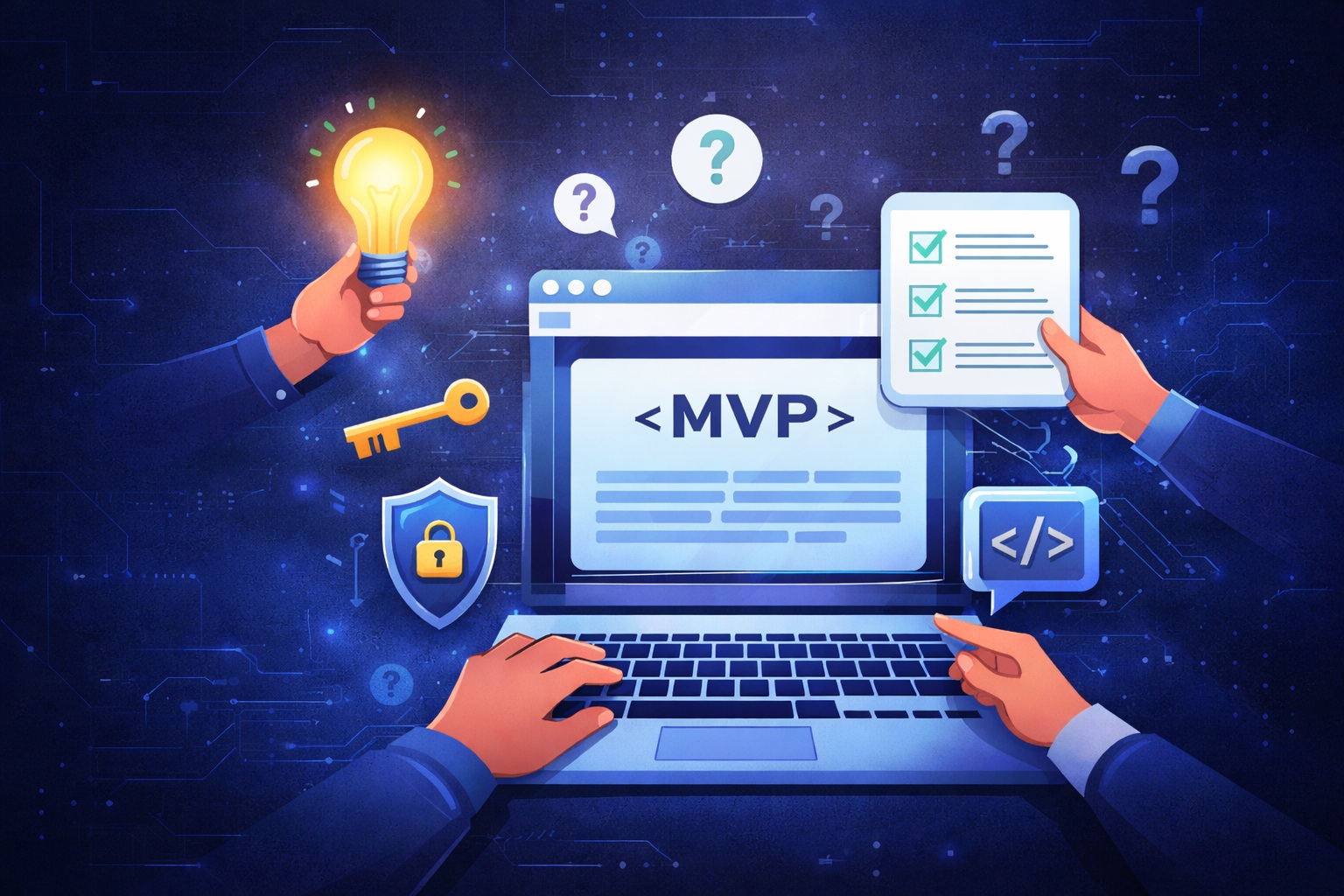
How Agentic AI Coding Supports Rapid MVP Development
For startups and innovation labs, the goal is to reach a Minimum Viable Product (MVP) as fast as possible. Agentic AI coding excels here by automating the setup of boilerplate code, database schemas, and API structures. What used to take a month of foundational work can now be completed in a few days. This allows founders to focus on the unique value proposition of their software rather than the plumbing.
Future Outlook: What Agentic AI Coding Will Enable in the Next 2–5 Years
In the coming years, we will see the rise of multi-agent systems. Instead of one agent, a team of specialized agents—one for security, one for frontend, one for DevOps—will collaborate to build entire applications. We may also see “self-healing” infrastructure, where agentic AI monitors production logs and automatically deploys patches to fix performance regressions in real-time. The barrier to entry for creating complex software will continue to drop, leading to an explosion of niche, highly-customized software solutions.
Conclusion
Agentic AI coding represents a paradigm shift from simple assistance to true partnership in the software development process. By leveraging autonomy, planning, and tool usage, these systems allow developers to focus on high-level problem solving while the AI handles the execution and iteration. While risks regarding security and code quality remain, the benefits of speed, cost reduction, and scalability are too significant to ignore. For businesses looking to thrive in an increasingly digital world, adopting agentic workflows is no longer optional—it is a competitive necessity.
To explore how these technologies can transform your business and to leverage professional expertise in this new era, reach out to vibe coding services to learn more.