
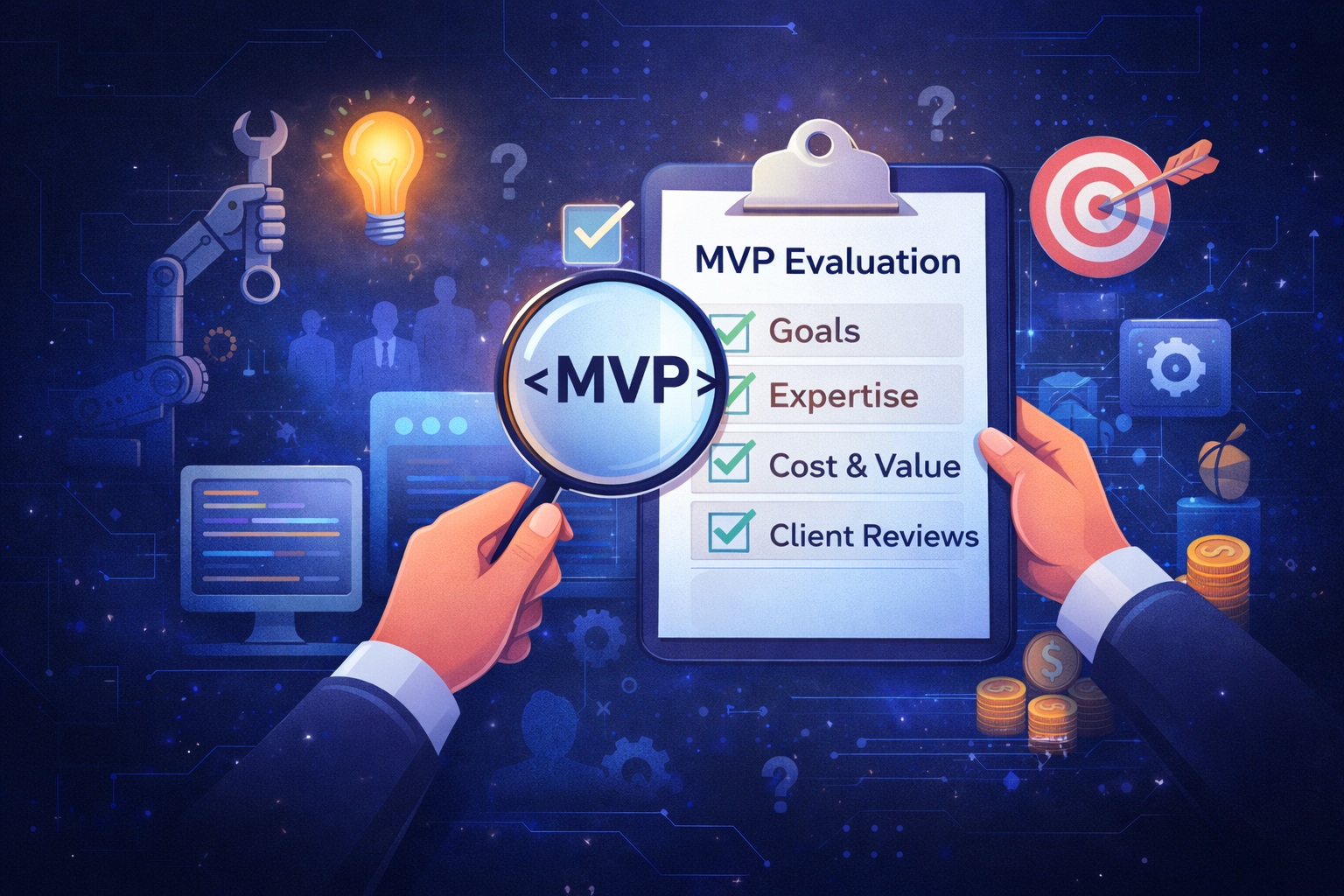
Selecting an MVP development partner ranks among the most consequential early decisions startup founders face. The right company accelerates validation, while the wrong choice drains resources and delays market entry—potentially costing you critical timing advantages in competitive markets. Founders who understand how to choose an MVP development company early dramatically increase their chances of launching successfully.
In 2026, the development landscape has evolved significantly with vibe coding tools, AI-assisted platforms, and new methodologies transforming how MVPs are built. This creates both opportunities and complexity when evaluating potential partners. Traditional evaluation criteria still matter, but understanding modern capabilities separates informed decisions from risky gambles. Learning how to choose an MVP development company in this evolving environment requires a deeper look at both traditional and AI-driven capabilities.
This guide presents a comprehensive framework for evaluating MVP development companies, covering technical capabilities, communication practices, cost structures, and strategic fit that determines project success. Throughout this framework, you’ll see practical guidance on how to choose an MVP development company that aligns with your product vision and growth objectives.
Understanding How to Choose an MVP Development Company
MVP development companies specialize in transforming business concepts into functional, market-ready products containing just enough features to validate core assumptions. The best partners bring multidisciplinary expertise—combining software engineering, UX/UI design, and product strategy to guide founders through technical and strategic decisions.
These companies employ lean development methodologies that enable rapid iteration based on user feedback. Rather than building comprehensive products upfront, they help founders identify minimal tests that validate key assumptions quickly and affordably.
Why Selection Matters
Your development partner significantly impacts not just whether you launch, but how well your product resonates with users and positions for growth. The right company brings technical skills, industry insights, and collaborative processes that accelerate learning and adaptation. This is why understanding how to choose an MVP development company strategically—not just tactically—is essential for long-term product success.
Poor selection leads to missed deadlines, budget overruns, technical debt, and products that don’t address real market needs. The most expensive development partner isn’t necessarily the best, nor is the cheapest typically the wisest investment. Value emerges from alignment between your needs and their capabilities.
10 Strategies for Evaluating Development Partners
1. Define Your MVP Goals First
Before evaluating any companies, clarify exactly what your MVP needs to achieve. Are you validating market demand, attracting investors, or launching a customer-facing product? Different goals demand different approaches and capabilities.
A quick prototype for investor presentations requires different expertise than a production-ready SaaS platform. Without clear objectives, you risk choosing partners based on impressive portfolios or compelling sales pitches rather than actual fit for your specific needs.
Implementation: Document your MVP’s primary purpose, success metrics, must-have features, timeline constraints, and budget parameters. Use these as your evaluation checklist when interviewing potential partners. Share them upfront to assess how well companies understand your unique requirements.
Why it matters: Clear goals enable meaningful comparisons between companies and ensure you evaluate capabilities relevant to your actual needs rather than generic competencies.
2. Conduct Paid Discovery Engagements
Before committing to full development contracts, invest in short paid discovery phases with top candidates. A one-week scoping workshop or UI/UX design sprint reveals how agencies actually work—their communication style, problem-solving approach, and understanding of your business.
This “discovery test” provides real-world assessment beyond sales presentations. You observe responsiveness, technical thinking, and collaboration dynamics under actual working conditions.
Implementation: Define a clear mini-project with specific deliverables and timelines. Pay market rates for this trial engagement. Evaluate not just the output but the process—communication quality, proactive problem-solving, and ability to translate requirements into actionable plans.
Why it matters: Discovery phases minimize risk of costly mismatches. Red flags that emerge in controlled tests would become expensive problems during full development.
3. Evaluate Relevant Experience Deeply
Portfolio quality matters, but relevance matters more. Companies with extensive experience building MVPs similar to yours navigate challenges more effectively than those building their first project in your domain.
Review detailed case studies that outline problems, solutions, and measurable outcomes. Request access to live applications they’ve built. Speak with references specifically about challenges and how they were handled.
Implementation: Shortlist companies with demonstrated success in your industry or similar product categories. Ask for specific MVP examples, then dig into technical approaches, user feedback incorporation, and post-launch evolution. Verify claims through reference calls and product reviews.
Why it matters: Domain experience accelerates development and reduces costly mistakes that generic agencies might make learning your market’s nuances.
For modern approaches, consider companies specializing in vibe coding tools that can dramatically accelerate development timelines.
4. Analyze Client Reviews Systematically
Third-party reviews on platforms like Clutch, G2, and LinkedIn provide unfiltered perspectives on company performance. These testimonials reveal patterns in communication, reliability, and technical execution that sales materials obscure.
Look beyond average ratings to specific feedback about responsiveness, problem-solving, and project management. Companies with consistently strong reviews across multiple platforms demonstrate reliable performance.
Implementation: Search for companies across multiple review platforms. Filter for feedback from startups or MVP projects similar to yours. Note recurring themes in both positive and critical reviews. Assess how companies respond to negative feedback—professional responses indicate accountability.
Why it matters: Authentic client experiences predict your likely experience better than curated portfolios or sales presentations.
5. Assess Communication and Collaboration
Technical skills matter little if communication breaks down. Successful MVP development requires continuous alignment, rapid feedback incorporation, and transparent problem-solving—all dependent on effective communication practices.
Evaluate companies’ project management methodologies, communication frequency, reporting transparency, and responsiveness. These factors determine whether development feels collaborative or adversarial.
Implementation: Ask about project management approaches—do they use Agile frameworks that enable regular feedback and iteration? Request sample communication plans and reporting templates. Schedule discovery calls to gauge responsiveness and clarity. Ask for examples of how they’ve handled project pivots or challenges.
Why it matters: Poor communication causes more project failures than technical shortcomings. Strong collaboration enables adaptation as you learn from users and markets.
6. Evaluate Technical Expertise Thoroughly
Your MVP’s technical foundation determines whether it can scale and evolve based on feedback. Professional SaaS MVP development services focus on building a secure, multi-tenant architecture from day one, preventing expensive technical debt as your user base grows.
Strong technical partners explain architectural decisions clearly, plan for scalability from day one, and implement security best practices appropriate to your data sensitivity.
Implementation: Review portfolios focusing on technical sophistication of similar projects. Ask how they choose tech stacks and request justification for recommendations. Discuss their approaches to scalability, security, and maintainability. If you lack technical background, involve a trusted technical advisor in evaluation.
Why it matters: Technical debt accumulated during rapid MVP development becomes increasingly expensive to address later. Professional architecture prevents problems that could derail scaling.
Companies like Vibe Coding by Scopic Inc combine modern AI-assisted development tools with professional technical expertise, delivering speed without sacrificing architectural soundness.
7. Understand Cost Structures Holistically
MVP development costs extend beyond initial quotes. Different pricing models—fixed-price, time-and-materials, or dedicated teams—suit different scenarios and risk profiles.
Fixed-price contracts provide budget predictability but limit flexibility when requirements evolve. Time-and-materials models enable adaptation but require active project management. Understanding tradeoffs helps you choose appropriate structures.
Implementation: Map your MVP’s core features and likely evolution paths. Ask companies to explain their pricing models and what happens when scope changes. Compare not just prices but included services—testing, deployment, post-launch support. Evaluate whether models align with your anticipated iteration needs.
Why it matters: Focusing solely on lowest initial cost often produces expensive results when quality issues emerge or inflexibility prevents necessary adaptations.
8. Assess Modern Tool Proficiency
In 2026, leading development companies leverage AI-assisted platforms and vibe coding tools that dramatically accelerate development. Companies proficient with tools like Lovable, Replit, Cursor, or v0 by Vercel can deliver MVPs faster and more affordably than those using only traditional approaches.
However, tool proficiency alone isn’t enough—companies should know when modern platforms suit requirements and when traditional development is more appropriate.
Implementation: Ask specifically about modern development tools and platforms. Request examples of projects where tmodern development tools vibe coding approaches. Assess whether they recommend tools strategically based on project needs or apply them universally regardless of fit.
Why it matters: Modern tools can reduce development timelines by 50-70% for suitable projects. Companies without this expertise can’t offer these advantages, potentially putting you at competitive disadvantages.
9. Evaluate Post-Launch Support
MVP development doesn’t end at launch. The critical weeks immediately following release often reveal issues testing missed and require rapid responses. Companies offering structured post-launch support demonstrate confidence in their work and commitment to your success.
Clear warranty periods, responsive bug-fixing, and ongoing enhancement capabilities enable smooth transitions from launch to growth phases.
Implementation: Ask explicitly about post-launch support—what’s included, for how long, and under what terms. Clarify what constitutes warranty work versus billable enhancements. Request examples of how they’ve supported past clients post-launch.
Why it matters: Early-stage startups rarely have in-house capacity to address post-launch issues. Knowing your development partner stands behind their work provides essential security during critical early weeks.
10. Assess Strategic Alignment
Beyond technical execution, strong development partners provide strategic product thinking. They challenge assumptions constructively, suggest feature prioritization based on validation goals, and help you avoid common pitfalls.
This strategic layer separates partners who accelerate learning from vendors who simply execute requirements without questioning whether they serve validation objectives.
Implementation: During evaluation, present your MVP concept and feature list. Assess whether companies ask probing questions about assumptions, suggest alternatives, or simply agree to build what you’ve specified. Strong partners challenge thoughtfully while respecting your domain expertise.
Why it matters: Strategic partners help you build the right MVP, not just build your MVP right. This distinction often determines whether products achieve validation or simply launch.
Red Flags to Watch For
Certain warning signs indicate potential problems regardless of portfolio quality or pricing. Being alert to these red flags helps you avoid partnerships likely to disappoint.
Communication Red Flags
Slow responses during sales processes typically worsen under contract. Inability to explain technical concepts clearly suggests they either don’t understand them deeply or can’t communicate effectively—both problematic.
Reluctance to provide references, particularly from challenging projects, indicates potential issues with client relationships or execution quality.
Technical Red Flags
Generic tech stack recommendations without project-specific justification suggest inflexible thinking. Inability to discuss scalability, security, or maintenance planning indicates limited experience with products that achieve traction.
Resistance to discussing IP ownership or providing source code access reveals concerning business practices that could constrain your future options.
Process Red Flags
Absence of formal change management processes suggests projects often experience scope creep and budget overruns. Unwillingness to conduct paid discovery phases may indicate concerns about showcasing actual capabilities.
Unclear post-launch support policies or vague warranty terms often lead to disputes when issues emerge after delivery.
Modern Development Advantages
The 2026 development landscape offers unprecedented advantages for founders who choose partners proficient with modern tools and Rapid Prototyping Platforms.
Vibe Coding Acceleration
Companies specializing in vibe coding platforms deliver MVPs 2-3x faster than traditional approaches while maintaining professional quality standards. This acceleration enables faster validation, earlier revenue, and more iteration cycles before capital runs out.
AI-Assisted Development
Leading companies leverage AI coding assistants alongside development platforms, further accelerating implementation while maintaining code quality. This technology enables more sophisticated MVPs within typical startup budgets.
Validation-First Approaches
Modern agencies emphasize validation over feature completeness, helping founders identify minimal tests that answer key questions quickly. This lean approach, enabled by rapid development tools, reduces waste and accelerates learning.
Making Your Final Decision
After evaluating multiple companies against these criteria, compare them systematically. Create scorecards covering technical capabilities, relevant experience, communication quality, modern tool proficiency, cost transparency, and strategic thinking.
Don’t let impressive portfolios alone drive decisions—past work doesn’t guarantee future performance or fit for your specific situation. Trust your assessment of communication and responsiveness during evaluation. Companies that communicate clearly and responsively during sales typically maintain those standards during execution.
Consider running paid discovery phases with your top 2-3 choices if budget permits. The investment often prevents much more expensive mistakes.
Questions to Ask Finalists
Before making final decisions, ensure you’ve addressed these critical questions:
- Will I own all source code and IP immediately upon completion?
- Why do you recommend this specific tech stack for my project?
- What post-launch support is included, and for how long?
- How do you handle scope changes during development?
- Will I have direct access to developers, not just project managers?
- How do you plan for security and scalability from day one?
- What exactly transfers to me at project completion—code, documentation, access credentials?
- Describe your QA process in detail.
- Can you share an example of a project that pivoted significantly during development?
- What is your typical project timeline for an MVP like mine?
Strong answers to these questions indicate reliable partners. Vague responses or deflection suggest potential issues.
For more detailed guidance on these questions, see our comprehensive guide on essential questions to ask MVP development companies.
The Value of Specialized Partners
While generalist development agencies serve many purposes, companies specializing in MVP development—particularly those proficient with modern vibe coding tools—offer distinct advantages for startups.
These specialists understand startup constraints, validation methodologies, and lean approaches deeply. They’ve accumulated patterns and best practices specifically for rapid MVP development that generalists lack.
Consider whether your project benefits more from broad experience or specialized MVP expertise. Often, the latter accelerates validation more effectively while controlling costs better.
Ready to Choose Your MVP Development Partner?
Selecting an MVP development company requires systematic evaluation across technical capabilities, communication practices, relevant experience, modern tool proficiency, and strategic alignment. The framework presented here helps you assess companies comprehensively rather than relying on portfolios or pricing alone.
Remember that the cheapest option rarely proves most cost-effective, nor does the most expensive necessarily deliver superior value. The right partner aligns capabilities with your specific needs, communicates effectively, and brings both technical excellence and strategic product thinking.
Vibe Coding by Scopic Inc specializes in modern MVP development using vibe coding platforms like Lovable, Replit, and Figma. Our approach combines the speed advantages of AI-assisted tools with professional consulting, quality assurance, and strategic guidance that ensures MVPs are built right and built for validation.
Schedule a consultation to discuss your MVP project. We’ll help you understand which modern tools suit your requirements, provide transparent timelines and pricing, and outline how our specialized approach accelerates your path from concept to validated product.